The AI-Care consortium meets for a full day of group updates on Friday, 13 November 2026. Talks cover synthetic and single-cell data, glioblastoma organoids, surface proteomics, and mathematical models of cell-state dynamics.
- Date Friday, 13 November 2026
- Time 09:00–16:30
- Venue Room 42-221, Department of Economics (Wirtschaftswissenschaften), RPTU Kaiserslautern
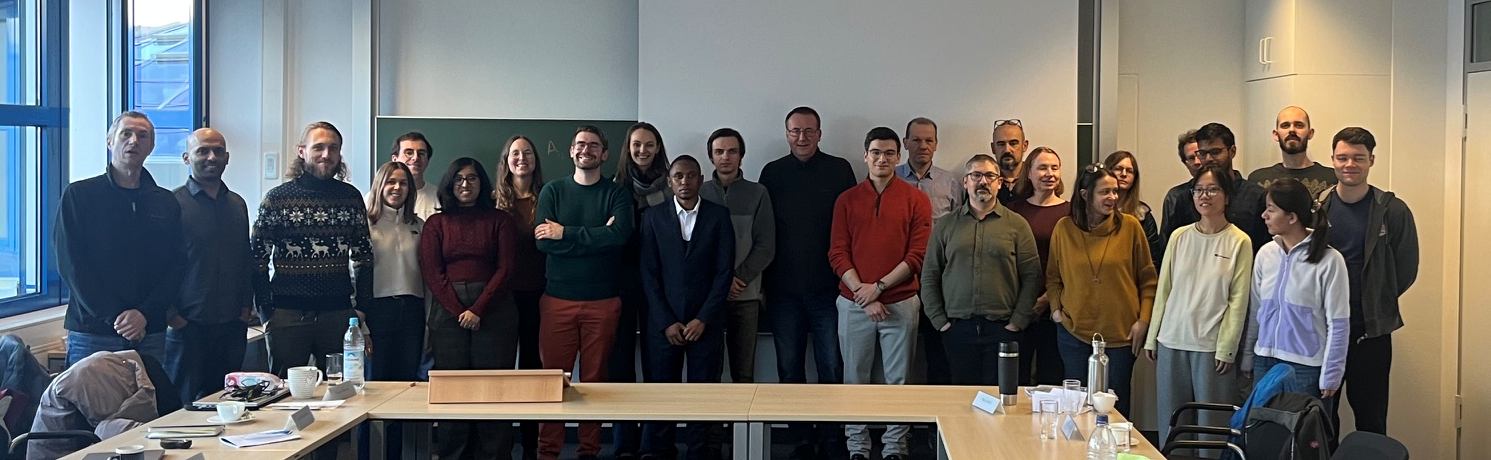 The consortium at the annual meeting, 13 November 2026.
Programme
| Time | Speakers | Contribution |
|---|---|---|
| 09:00–09:05 | Welcome | |
| 09:05–09:35 | Phil Sidney Ostheimer Sophie Fellenz |
Generating Synthetic Sparse RNA-seq Data with Diffusion Models |
| 09:35–10:05 | Andriy Balinskyy Marius Kloft |
Neural Representation Learning for Single-Cell RNA Sequencing Data |
| 10:05–10:35 | Vijay Arvind Rengaraj Naim Bajcinca |
Latent transport for single cell perturbation prediction |
| 10:35–10:50 | Break | |
| 10:50–11:20 | Chen Jin Haikun Liu |
Update on LEGO 2.0 |
| 11:20–12:10 | Maria Jerome Bernhard Radlwimmer Jean Radig Carl Herrmann |
Treatment and Recovery in Glioblastoma Organoids: Insights from APEX1 and STAT3 inhibition using survival analysis, imaging and scRNA sequencing |
| 12:10–13:00 | Lunch | |
| 13:00–13:30 | Tamara Hamann Zuzana Storchova |
Modelling recurrent GBM aneuploidies in iPSCs and cerebral organoids |
| 13:30–14:00 | Gina Maria Gräßle Tanja Maritzen |
Characterizing the Glioblastoma Surface Proteome by Mass Spectrometry using Organoids |
| 14:00–14:30 | Sandesh Hiremath Markus Hess |
Lévy-Driven Single-Cell Omics Regulatory Dynamics: GRN-conditioned transitions & latent perspectives |
| 14:30–14:50 | Break | |
| 14:50–15:20 | Michael Urs Lars Kastor Anna Hundertmark |
Macroscopic PIDE-model for cell-state representation in meta-module-latent-space: from interpretability and applicability to parameter-identification, Part I |
| 15:20–15:50 | Maoni Ngowa Msinda Nicolas Gauger |
Macroscopic PIDE-model for cell-state representation in meta-module-latent-space: from interpretability and applicability to parameter-identification, Part II |
| 15:50–16:30 | All | Discussion and future plans |